The Local Quality of Government Project
The Local Quality of Government project (LoQoG) aims to collect municipal/Local Administrative Unit (LAU)1 level data across 35 countries in Europe (EU, EFTA, and UK). The project is a collaborative initiative that will organise rich but currently fragmented local data across Europe into the first pan-European Local Quality of Government Dataset.
The Dataset
The publicly available dataset will contain yearly data for a series of demographic, economic, political, and social indicators from 2014-2024. Data is made available both with and without geographic features, facilitating merging with higher-level (e.g., NUTS) geographic units. All administrative boundaries and identifiers are fully integrated with the modification of municipal boundaries over time.
The dataset will provide unparalleled depth and breadth for data on the Quality of Government in Europe. Future iterations of the project will extend the geographic and temporal scope of data coverage.
Unit of Analysis
We approach the unit of analysis from the perspective of local self-rule, or local autonomy. We define this as the legally and institutionally grounded capacity of local government units (operating within clearly demarcated territories) to make binding decisions for local residents and manage resources independently of higher levels of government. The existence of an effective "policy space" (Ladner et al., 2016, p. 325)2 in which local governments can design and implement a range of policies distinguishes local autonomy from mere local administration, where authorities primarily execute policies determined by higher-level governments.
Following (Lidström, 1998)3, we define a local government as a unit that (1) possesses a clearly delineated territory, (2) has legislative and executive institutions, (3) holds the authority to make binding decisions for local residents, and (4) enjoys a degree of autonomy in managing local affairs and resources independently of higher levels of government. While decision makers are anchored locally, "they may be, but do not need to be, elected in accordance with democratic principles" (Lidström, 1998, p. 110).
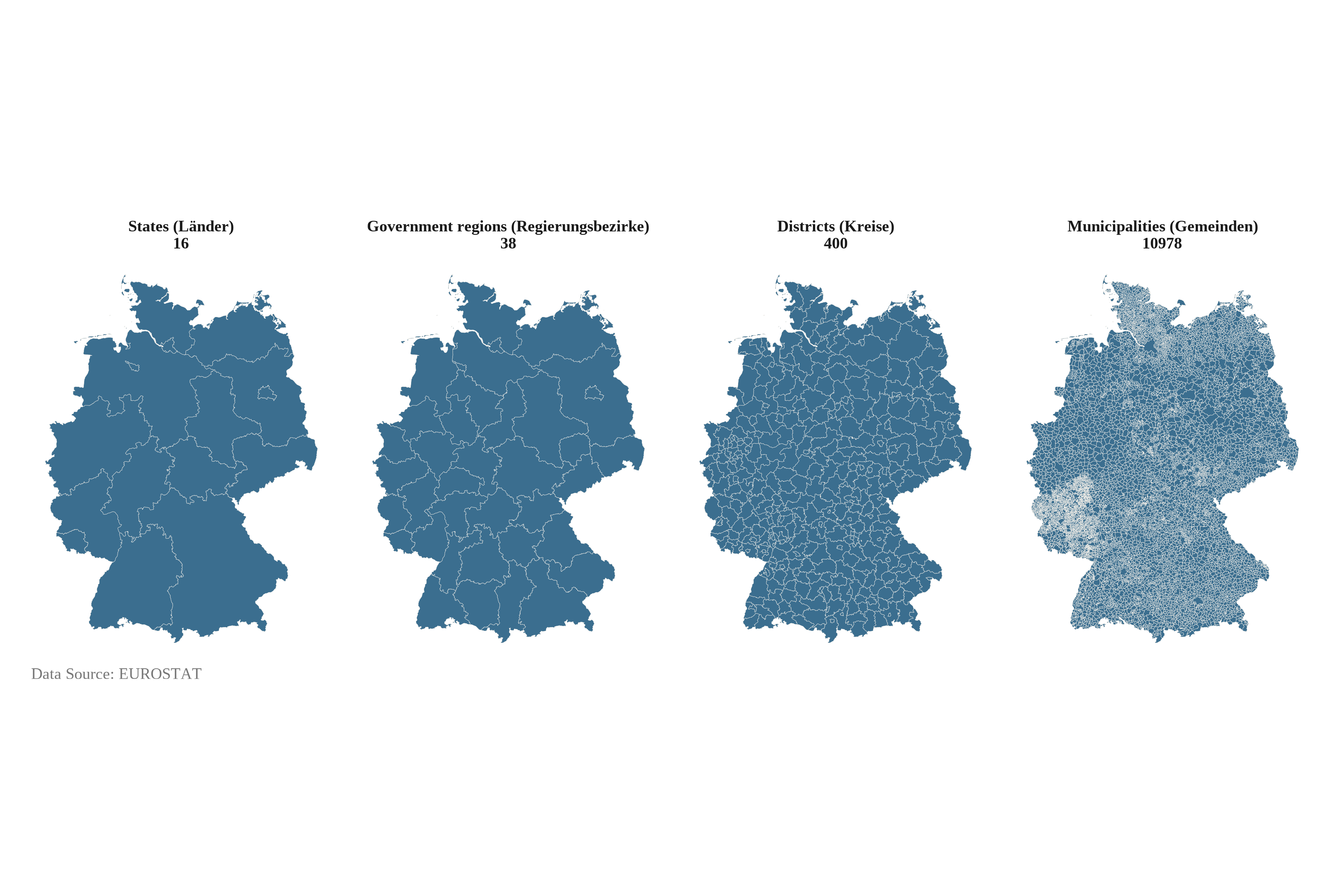
Although some countries feature multiple tiers of subnational government—as in Germany, where three levels exist (see Figure 1)—we focus on the lowest level within each country's government hierarchy. Across Europe, this level is most commonly referred to as the municipality (Ladner et al., 2016), although country-specific terminology varies (e.g., commune in France and Luxembourg, Gemeinde in Germany, or gmina in Poland). We therefore adopt municipalities as our unit of analysis, as they constitute the primary institutional arena where local autonomy is exercised and where decisions with direct implications for local communities are made and implemented.
Administrative Levels in Germany
About QoG Institute
We are an independent research institute affiliated with the Department of Political Science at the University of Gothenburg. In total, we are around 35 researchers conducting world-leading research on the causes and consequences of corruption and the quality of government. The number of researchers makes us one of the largest research centers in the world in our field. QoG Data offers open-access datasets—both compilations from other sources and original content datasets—so users can learn, research, and better understand the concepts relating to Quality of Government. More information can be accessed on our official website.
Notes
-
LAU; our units in some cases do not match the Eurostat level. For example, in the case of Portugal, Eurostat uses the freguesia level, but we use the município level. ↩
-
Ladner, A., Keuffer, N., & Baldersheim, H. (2016). Measuring local autonomy in 39 countries (1990--2014). Regional\ & Federal Studies, 26(3), 321--357. ↩
-
Lidström, A. (1998). The comparative study of local government systems---a research agenda. Journal of Comparative Policy Analysis: Research and Practice, 1(1), 97--115. ↩