The LoQoG typology of municipal spatial changes
We conceptualize municipal spatial change as a transformation between two time points: one preceding a territorial alteration (t) and one following it (t + 1). Following (Goerlich & Ruiz, 2018)1, we distinguish between observed spatial outcomes and the underlying territorial alterations that generate them. Unlike (Goerlich & Ruiz, 2018)1, however, we systematically attribute all observed spatial changes to specific types of territorial alteration, including previously unidentified forms, thereby avoiding residual categories such as "unspecified disappearance" or "unspecified emergence".
Figure 1: Typology of municipal border changes
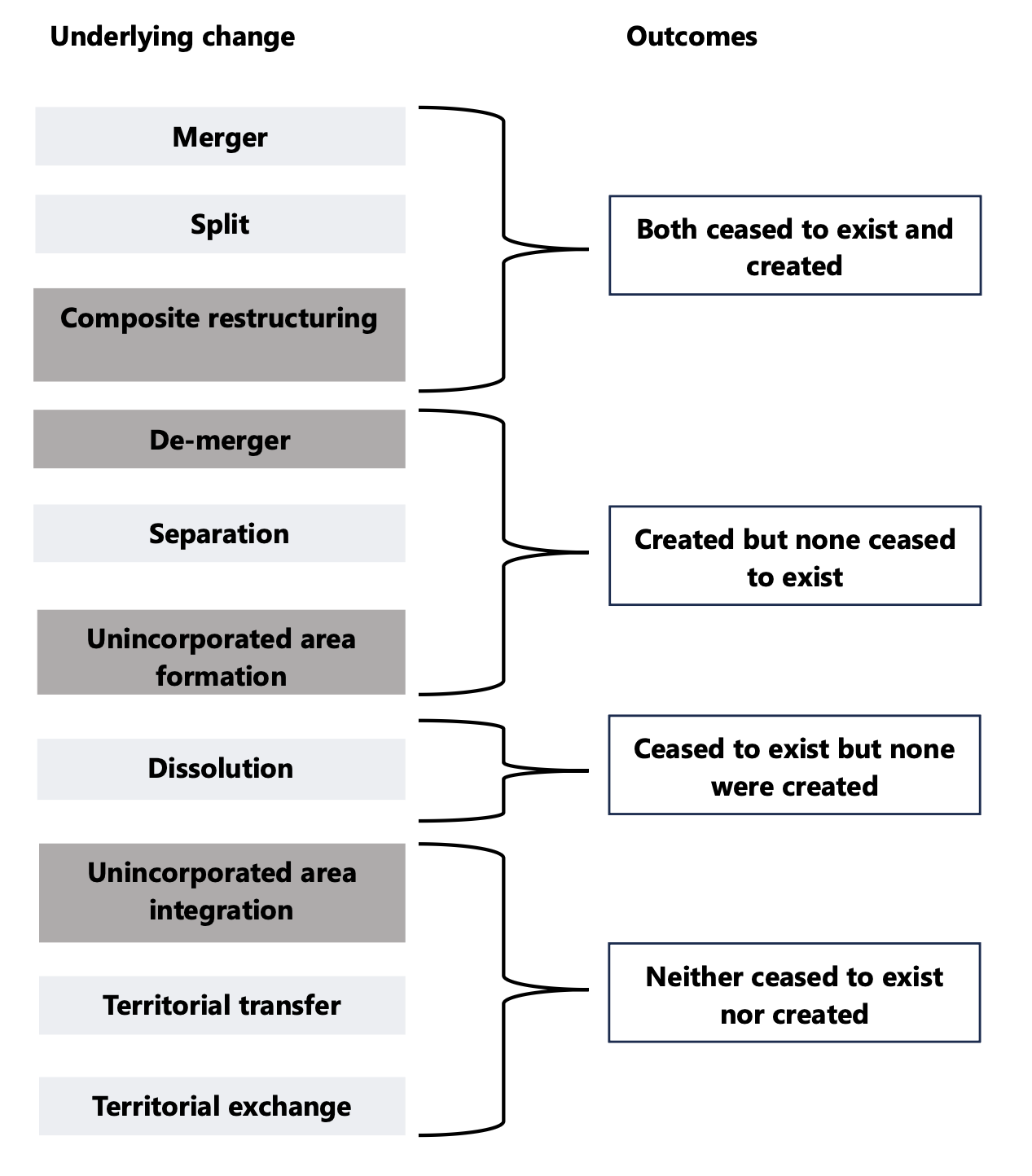
Geographical changes
Both ceased to exist and created2
-
Merger
A new municipality is created whose territory results from the union of two (simple) or more than two (multiple) pre-existing municipalities.
-
Split
One municipality is dissolved and its territory divided among two (simple) or more than two (multiple) newly established municipalities, none of which retains the legal or administrative identity of the original.
-
Composite restructuring
Simultaneous dissolution, merger, or territorial transfer of multiple municipalities, reorganizing entire or partial territories into one or more newly created municipalities.
Created but none ceased to exist
-
De-merger
A municipality that previously took part in a merger (simple or multiple) is re-established with boundaries matching its territory prior to the merger. Can happen for one (simple) or more than one (multiple) former municipality at once.
-
Separation (secession)
A new municipality is created by separating part of the territory from one (simple) or more than one (multiple) existing municipality, which continues to exist.
-
Unincorporated area formation
A new municipality is formed from territory that was not previously organized as a municipality.
Ceased to exist but none were created
-
Dissolution
A municipality ceases to exist as a legal-administrative entity and its territory is redistributed among existing municipalities.
Neither ceased to exist nor created
-
Unincorporated area integration
Previously non-municipal territory is incorporated into one (simple) or more than one (multiple) existing municipality.
-
Territorial transfer
Territory moves between municipalities without either being dissolved — as a one-way national transfer, a mutual national exchange between two municipalities, or an international transfer across a country border.
Non-geographical changes
-
Non-geographic
An administrative change with no boundary change: a name change, an id change, or both a name and id change at once.
References
-
Goerlich, F., & Ruiz, F. (2018). Typology and representation of alterations in territorial units: A proposal. Journal of Official Statistics, 34(1), 83--106. ↩↩
-
We consider each change category as a relationship between two points in time — the situation before and after the change — and classify transformations based on whether municipalities were dissolved (i.e., ceased to exist as independent administrative units) or created (i.e., new administrative units were formed as a result of the change). ↩